
Fortune features Heata
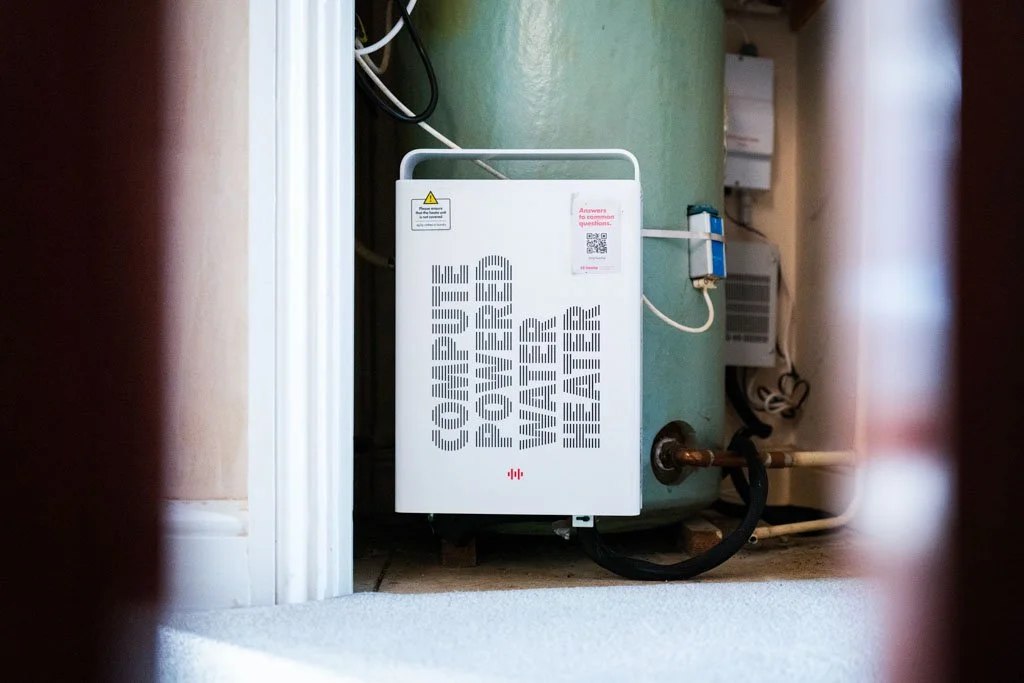
Heata: turning the data center boom into cheaper heat
Link to the article: https://fortune.com/article/what-are-the-startups-installing-tiny-data-centers-in-peoples-homes-to-reduce-strain-on-electrical-grid/
Every projection of the AI build-out says the same thing: too much compute demand, not enough grid to run it on. McKinsey puts data center capital expenditure at $7 trillion through 2030. Goldman Sachs expects US household electricity bills to rise 6% over the next year just to carry the load. In parts of Texas, projected water use for cooling alone is forecast at 399 billion gallons by 2030. The industry's answer so far has been to build bigger, further from people, and closer to whatever power and water it can find. We think that's the wrong direction, and we've support Heata spend the last several years building the alternative.
The idea
A server generates heat as a byproduct of doing work. Centralised data centers spend enormous sums cooling that heat and throwing it away. Heata install the same servers inside homes instead, capture the heat with a thermal conductor, and route it straight into the household's hot water cylinder. The compute still does exactly the same paid work for cloud and AI workloads it would do in a warehouse outside town. The only thing that changes is where the heat goes: instead of a cooling tower, it goes into a shower.
That means every unit Heata deploy creates two things at once - a slice of distributed compute capacity for an industry that is capacity-constrained everywhere, and a lower heating bill for the household hosting it. We're not aware of another model in this category that pays the homeowner in a currency they already feel every month.
What Heata has proven
The pilot fleet - just under 100 homes - has generated 1 gigawatt-hour of energy savings and 8 million litres of hot water, worth an estimated $55,000 in household bill savings to date. Of that saving, roughly 70% comes from displaced use of the home's own heating system and 30% from the cooling efficiency of the process itself. Small numbers by design - this is what a controlled pilot looks like before a scale-up - but the ratio is the important part: it holds up, and it's the number that scale from here, not a number we hope improves.
Why the UK is the right place to start
Heata didn't choose the UK by accident. Unlike housing markets built around combi and tankless water heating, a very large share of UK homes still run on a hot-water cylinder - the exact interface our technology needs. That's a large, specific, well-understood segment of the national housing stock, not a speculative fit they have to invent demand for. It also happens to be a market living through several consecutive years of high energy costs, where "we'll cut your heating bill" is one of the easiest sentences a homeowner, a housing association, or a housebuilder can say yes to.
Where the next capital takes heata.
We see three concrete paths to scale, and we're building the operational capability for all three in parallel:
New-build partnerships with UK housebuilders, installing at construction rather than retrofit - the model our US peers are already proving out with homebuilders there, adapted to UK building standards and energy performance requirements.
Retrofit at scale through housing associations and government-backed energy schemes, where our proposition - lower bills funded by compute revenue, not grant money - is a rare fit for public and social housing budgets under real pressure.
Grid services revenue, layering payments from UK demand-flexibility markets on top of our existing compute and heat-saving revenue, as our footprint becomes large enough to matter to network operators managing peak load.
Every one of these is a distribution question, not a technology question. The hardware works. The heat transfer works. What we're raising for is the operational and commercial capacity to go from a controlled pilot to thousands of homes, with the partnerships that get heata there is already in motion.
The category is being proven around us
We're glad to see heata being mentioned alongside better-funded US peers building cabinet-sized data centers for homes and businesses - it means the thesis that compute doesn't have to live in a warehouse is no longer a niche argument, it's a live investment category, with real capital already validating the idea that grid strain has to be solved close to where people live, not just far away from them. Heata is building the version of it that pays the homeowner directly, in a UK market built for exactly this technology.